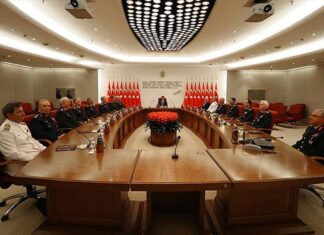
Another summer and another Supreme Military Council (YAŞ) that will probably be talked about intensively. Since the coup on February 28, 1997, summers have been critical and tense for the “Hizmet movement.” It’s not hard to predict that it’s going to be like this from now on.
From the beginning, the “congregation” aimed to achieve a civilian and military cadre approach and wanted to penetrate the Turkish Armed Forces (TSK). As a result, there were struggles to be a part of the decision-making process along with having Hizmet members in managing positions and, most importantly, in the command control mechanisms. The basic tenet of the “secret service” (mahrem hizmet) regarding the TSK is to bring “their fellow people” to key positions. The most famous method they employed to achieve this is the “fight against undesirables (menfi)” strategy.
“Undesirable”, in its simple definition, is the enemy of the congregation, has various minority roots (secretly Armenian, Greek/Pontus, Bagratuni, Sabbathaians etc.), is of a different sect, and can be grey wolf-nationalist. For years, the private lives of all TSK members who fall into this category are investigated, details are noted, relayed to the congregation and recorded, just to have congregation members rise the ranks. This acquired and collected personal information is supported by as many photos, videos, or documents as possible. And when the day comes, it’s either used to block promotions/assignments or to make the said people act/make decisions in the desired way. This “use” is done by anonymous letter of notice, disclosure on social media or by means of “threatening” the subject with these records.
In the struggle for this staffing in the most “predatory” way, “the congregation” has convinced its members through several very familiar “basic religious principles” to fit what they do in the framework of “Hizmet.” While these basic principles are the subject of another extended article, here are the most important ones:
-Elimination of the bad and harmful is more important than achieving the good.
-Necessities renders the forbidden permissible.
-Damage to an individual/smaller group is preferable to damage to the general public/larger group.
For the congregation, “hizmet” is unquestionably and indubitably innocent, sacred and all mistakes made in the name of “hizmet” are attributed to the individual. Even if the mistake is a result of consultation, the sin due to the error is nullified and those who were present in the consultation would be subject to divine rewards. Moreover, due to necessities, it could be decided to do things that are forbidden; as “Hizmet” strives for the “greater good” of the public, causing harm to individuals is permissible, despite their utter innocence. Working for the benefit of “humanity”, Hizmet must also eliminate “evilness and evils” and this is the most natural right.
Working with this mindset, the “secret services” of the congregation have attempted to eliminate all elements that could possibly challenge the movement in the near history. YAŞ has always been an important milestone in this regard. Commanding officers and promotions are vital to the presence of the congregation in the TSK. If the Hizmet movement failed to put a member to a key position, it tried to promote an alternative who were sympathetic to the movement, was religious/nationalist or not hostile/unfriendly, respectively. In this way, the congregation has also managed to accrue benefits for itself.
Expectations regarding YAŞ have ranged from knowing who will become the Chief of Staff in late ‘90’s and early 2000’s along with who will be the future force commanders to not promoting those “undesired” ahead of July 15. For instance, when Hüseyin Kıvrıkoğlu (whom the congregation deemed as “not the worst of among other”) succeeded İsmail Hakkı Karadayı, it was like a holiday for the movement. The congregation has done its best to ensure that Yaşar Büyükanıt and İlker Başbuğ did not become chiefs of staff, but were unable to prevent their promotion. It is also known that before YAŞ, “secret” structures had asked the members of the congregation to pray against the promotion of the undesired. We are confident that “civilian” and “military” secret imams and members who are trying to continue their presence and activities abroad are eagerly anticipating the results (retirements, promotions and extensions) of the 2021 YAŞ decisions, just to make disinformational comments on any development through social media.
Even though, the secret elements and cells within the TSK have been largely identified after July 15, the Supreme Military Council (YAŞ) will always be a primary agenda for the congregation. Isn’t this enough to show how that the Hizmet has parted its way from the concept of “religious community” and that the secret organization, which is called the Parallel State Structure, is the very core of the “congregation”?